
Skip to header Skip to main navigation Skip to main content Skip to footer

Search form

User account menu

  • Log in

Site branding

Home
American Precision Products
Custom Molding and Assembly

Main navigation

  • Home
  • Quality
  • About Us
  • Maps & Directions
  • Vendors
  • Contact Us
  • Quotations
      • Aerospace Molding and Assembly
      • Commercial and OEM
      • Energy Solor Wind Mining Oil and Gas Markets
      • Military Injection Molding and Assembly
      • Transportation Industry
      • Conductive Materials
      • Filled and Modified Resins
      • High Temperature Plastics
      • Silicone Rubber Molding
      • Thermoset Resins
      • Theromplastic Elastomer Molding
      • Plastic and Rubber Injection Molding
      • Design for Manufacturing
      • Compression and Transfer Molding
      • Insert and Overmolding
      • Micro and Miniature Molding
      • Mold and Tooling Building
      • Prototyping and Bridge Tooling
      • Aerospace Composites
      • Assembly and Finishing
      • Overseas Outsourcing
Industries Served

Aerospace, Military, Energy, Transportation, Critical OEM

Certifications

AS9100D Certified / CMMC / ITAR Registered

We are

A Woman Owned Small Business

Hand Load Mold Inserts

Breadcrumbs

Breadcrumb

  • Home
  • Hand Load Mold Inserts

Main page content

By EngineeringTeam | 2:57 PM CDT, Wed October 28, 2026

What is it?

Hand load mold inserts are mold components that are installed manually by an operator and then ejected with the molded part in order to create undercuts or threaded features.

Typical Method to Product Undercuts

Typically undercuts are created by side actions or core pulls that automatically retract at some point during the molding cycle.  These features can be quite expensive to build and take time.

Pro's and Con's

 Hand LoadCore Pull
Tooling CostCheaperMore Expensive.  Can be very expensive
Time to BuildFasterSlower
Part QualityLower: Seam lines are more pronounced and prone to more flashHigher: Seam lines are cleaner and less likely to flash
DurabilityLower: Hand loads, especially larger ones, are prone to damage from inserting into the mold or just being dropped.High: Actions are never removed from the mold.  They are more damage prone than fixed components
Part CostHigher: An operator is required by definition and parts run much slower.  If an operator is required for other reasons then this is not an issue.Lower: Typically runs automatically and quite fast.

When to use Hand Loads:

Use hand loads when tool cost or time to market is important or when part features cannot be produced any other way.

Use core pulls and side actions when part cost and quality are primary concern.

Example

In this example the green hand load insert (green) produces the threaded feature of the part ( purple).  The insert is unscrewed manually by an operator after ejection.  Multiple inserts are used so that a new part can be molded while the other is unscrewed.  In a traditional mold and expensive unscrewing mechanism would be employed.
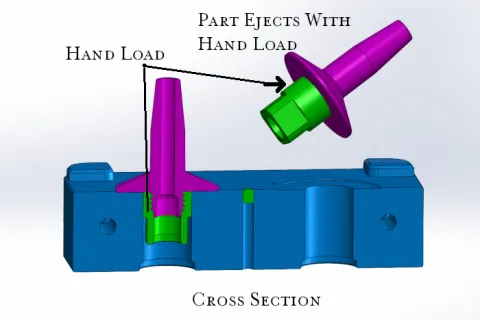
Example of hand loaded mold inserts

Engineering Team

  • Convert from Transfer & Compression
  • Critical Characteristics Defined
  • Equipment List
  • Hand Load Mold Inserts
  • Installing Inserts
  • Non-Export Tooling
  • Plastics References
  • Tool Building Schedule
  • Transferring Tooling
  • Transferring Tooling

American Precison Products

520 Green Cove Road SE
Huntsville, AL 35803 USA

800.889.7674
256.882.2121
256.882.2414

Footer menu

    • Conflict Minerals
    • Our Facility
    • Products
    • Confidentiality - Mutual Nondisclosure
    • Privacy Policy
    • Terms of Use

Copyright © 2026 American Precision Products - All rights reserved

APP